Setup Guide
Point the app at your game's config folder, pick a template for each device, and export.
Step 1: Download & Install
Grab the latest release (v2.3.0). Three builds are available:
- Windows installer is the one most people want. Unzip it and run the installer.
- Windows portable needs no installation. Unzip it wherever you like and run it from there.
- Linux ships as a tarball. Extract it and run the executable.
After installing, run Joystick Diagrams to launch the application.
Step 2: Install Your Plugins
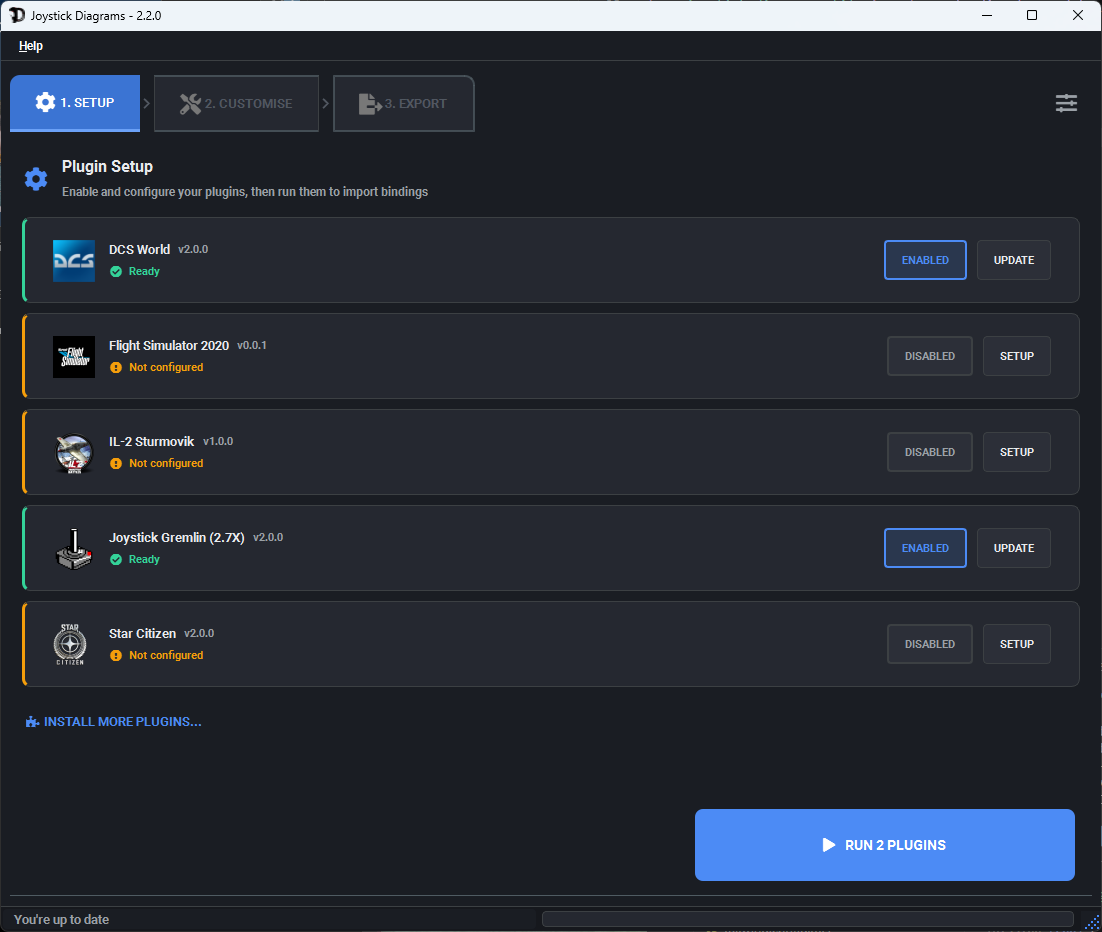
Plugins are separate downloads, so a fresh install has none. Open Settings → Plugins and install the ones you need from the built-in store: a parser plugin for each game or tool you use, plus any output plugins you want.
Every plugin, official and community, is listed there with its version and author. See the Plugins page for what's available, or the Installing Plugins guide for the trust model, updates, and manual installs. Installed plugins and their settings survive app updates, and each plugin updates independently of the app.
Step 3: Configure Plugins
Joystick Diagrams reads your existing game/tool configuration files. It never modifies your configurations in any way. You need to configure at least one plugin before you can use the tool.
DCS World
Select your DCS Saved Games folder (typically found in your user Documents or Saved Games directory), not the main DCS installation folder. This is where your user profile data and input bindings are stored.
The DCS plugin includes an option to exclude easy-mode aircraft variants. Enable this to filter out simplified training profiles so they don't clutter your binding list.
Microsoft Flight Simulator 2020
Select the folder containing your MSFS controller profiles. These are stored in your user AppData directory under
Microsoft Flight Simulator\Input. Point the plugin at this folder and it will discover all your
configured control profiles automatically.
IL-2 Sturmovik: Great Battles
Select your IL-2 data\input folder inside your IL-2 installation directory. The plugin reads your joystick configuration files and imports your bindings from all aircraft profiles.
Star Citizen
The application requires your ActionMaps.XML file. To locate or generate this file, follow the
Star Citizen Custom Profiles guide.
Joystick Gremlin
Select your Joystick Gremlin profile.xml file, the one you saved from within the Joystick
Gremlin application.
Step 4: Run Your Plugins
Click Run Plugin(s) to process your profiles. For large DCS installations with many aircraft, this may take a few seconds.
Step 5: View your bindings and customise as you see fit
Open Customise to review what the plugins found and shape it into the diagrams you want. The Customise area is split into four tabs, each handling a different part of your setup:
- Profiles: review the bindings each plugin imported. Browse every profile (aircraft, ship, mode) and check the bindings against your real setup. Profiles can be renamed or hidden here without touching the source files in your game.
- Devices: assign templates, rename, hide, or alias. Pick a template for each device so its buttons and axes land in the right place on the diagram. Rename devices to something you'll recognise, hide ones you don't care about, and alias duplicates so they share a single output. See the Device Management guide for the details.
- Labels: edit the text that appears on the exported diagram. Game action names are often verbose (Weapon Fire Primary Mode Toggle). Rewrite them to whatever reads cleanly on the page (Guns). The edits only affect your diagrams, never your game.
- Inheritance: merge profiles so shared bindings live on one diagram. Cascade bindings from a base profile into others so common controls aren't duplicated across every aircraft. See the Merging Bindings guide for how to chain them.
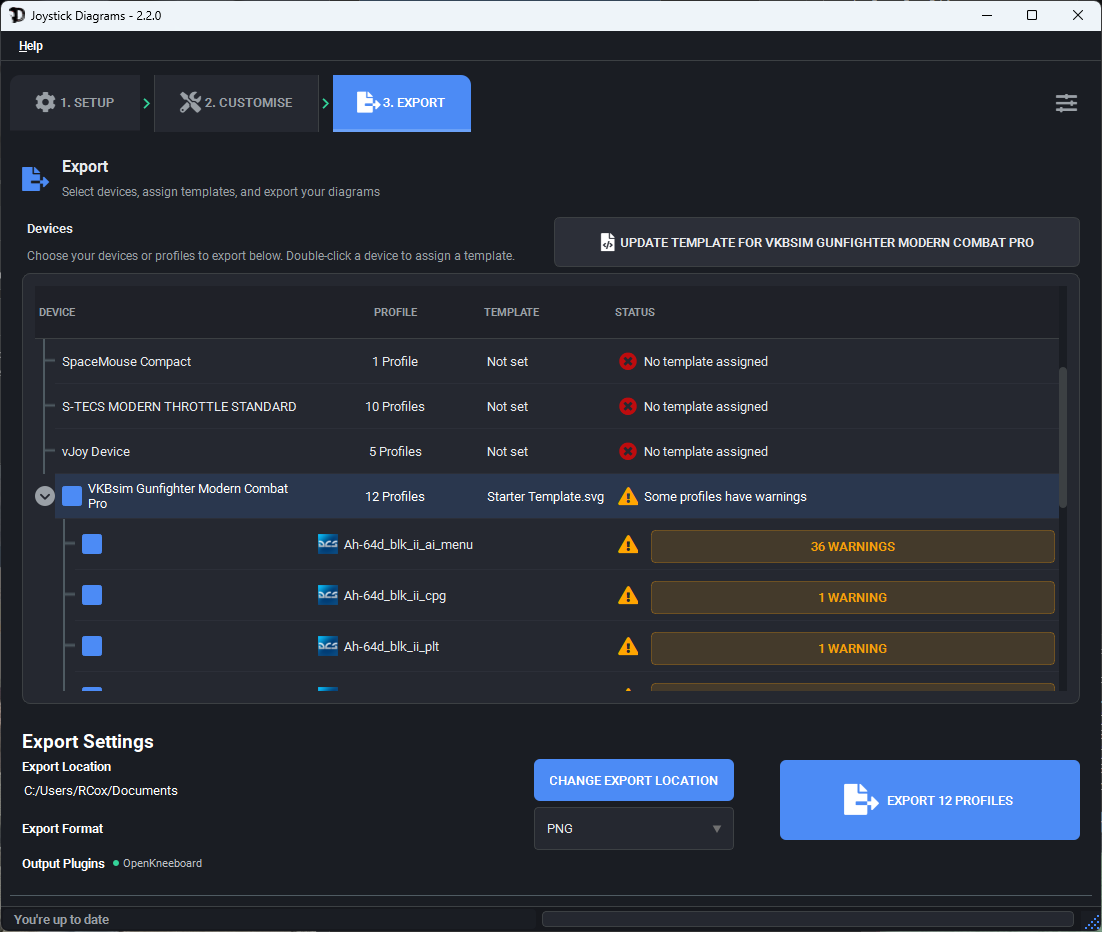
Step 6: Export
- Set your export output folder (remembered between sessions)
- Select the devices and/or individual profiles you want to export
- Click Export
Progress is shown during export. Exported items are listed at the end. Diagrams are saved as SVG or PNG files in the chosen location.